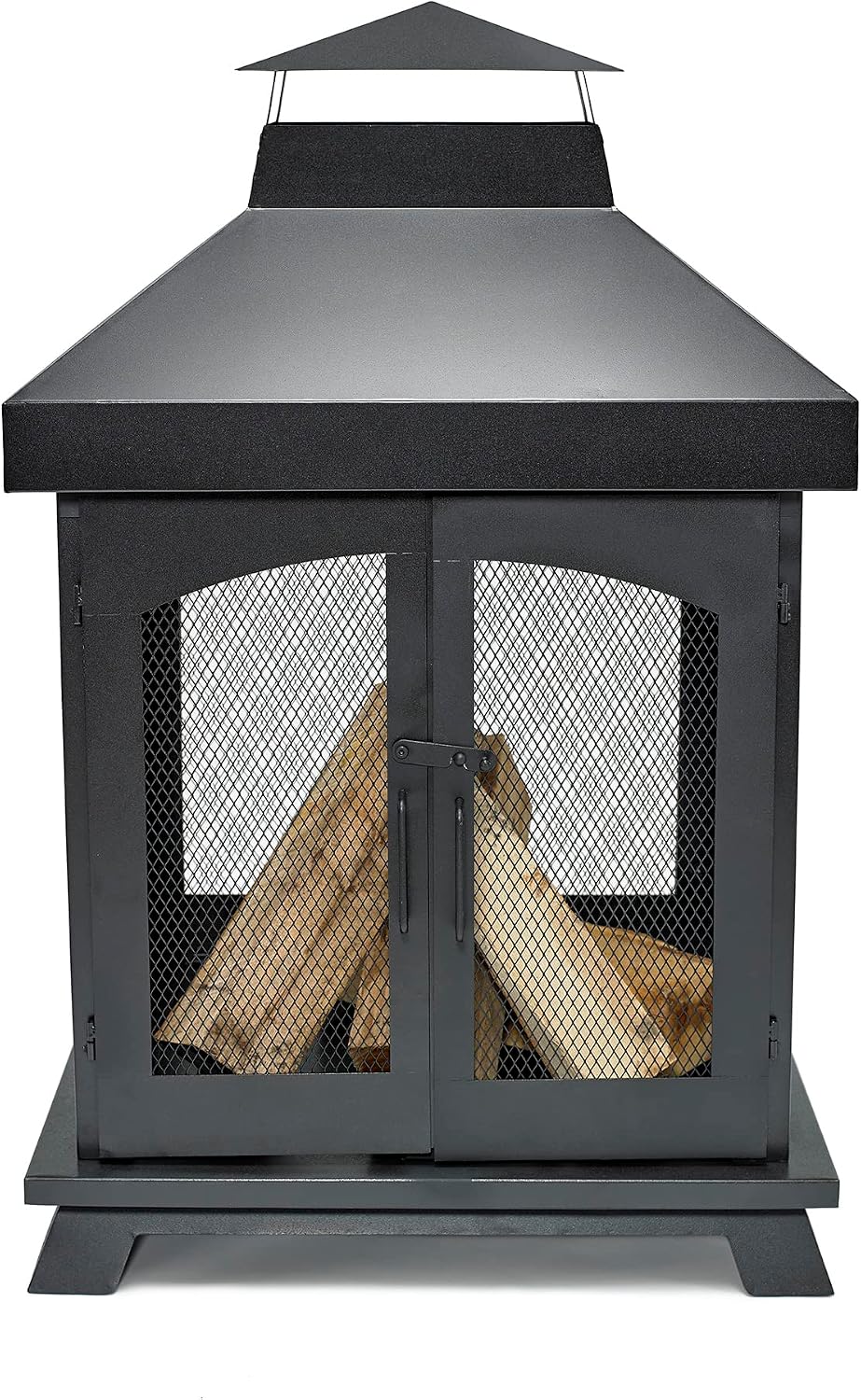
A freestanding outdoor fireplace is exactly what it sounds like: a self-contained firebox — the box where the fire burns — with its own chimney rising above it, standing on your patio without being built into a wall. The chimney does the same job it does indoors: it pulls combustion gases (smoke, carbon monoxide, heat) up and away from the fire and the people sitting around it. The catch is when you put that chimney under a covered patio or pergola. Suddenly you have a hot exhaust column trying to exit through — or dangerously close to — a roof structure. This guide breaks down exactly what clearance numbers govern that situation, how to read those numbers off a spec sheet, and which material choices actually survive the decision long-term. By the end you’ll have a clear decision framework for your current project, not a list of things to “check with your local authority” (though yes, you still need to do that — more on why below).
| EDITOR'S PICK[Sunjoy Outdoor Fireplace](https://www.amazon.com/dp/B0C3C3PFDW?tag=greenflower20-20) | Mid-tier36" Rectangular Steel Outdoor W… | Budget pickEndless Summer 45" Wood Burning… | |
|---|---|---|---|
| Material | Steel with tile | Steel | Steel |
| Cooking Grate | ✗ | ✓ | — |
| Spark Screen | ✓ | ✓ | — |
| Rain Cover | ✓ | — | — |
| Price | $530.10 | $199.00 | $169.99 |
| See on Amazon → | See on Amazon → | See on Amazon → |
Why Clearance Numbers Matter More Than You Think
“Clearance” in this context means the minimum air gap — measured in inches — between a hot surface (the chimney pipe, the firebox body, a spark arrestor cap) and any combustible material: wood framing, a vinyl soffit, a fabric pergola canopy, even certain composite decking that extends under the structure.
Two documents govern this nationally in the U.S. The first is NFPA 211, published by the National Fire Protection Association, which is the baseline standard for chimneys and venting systems. The second is UL 127, Underwriters Laboratories’ standard specifically for factory-built (prefab) fireplaces. Most freestanding outdoor fireplace units sold through landscape and hearth dealers will reference UL 127 listing on their spec sheet; if you’re specifying a masonry-ready prefab firebox and adding a separate flue liner, NFPA 211 becomes the primary document.
Here’s what those documents actually say in plain numbers for most configurations:
By the numbers:
- UL 127 factory-built units: minimum 2-inch clearance, chimney pipe to combustibles (varies by listed assembly — always verify against the specific listing)
- NFPA 211 masonry-adjacent prefab systems: 2-inch clearance to combustibles for listed, insulated flue pipe; 6-inch minimum for unlisted single-wall pipe
- Overhead clearance (pipe termination above a horizontal combustible surface like a pergola roof): 3 feet above the deck of the roof if the pipe passes through or terminates within 10 feet horizontally, per NFPA 211 Section 12.7
- Spark arrestor mesh opening: 3/8-inch to 1/2-inch (coarser meshes don’t catch embers; finer meshes clog with creosote faster)
The critical insight practitioners miss: the listed clearance on the spec sheet applies only to that specific listed assembly. If you swap in a different brand’s flue sections — say, mixing DuraVent DVL sections with a Selkirk firebox adapter — you have potentially broken the listing and are no longer covered by the tested clearances. Per the DuraVent DVL Product Installation Guide (2024), using any non-listed components in a listed system “voids the listing and may create a fire hazard.” That’s not boilerplate — it’s the reason local inspectors increasingly require documentation of the full component chain at permit review.
Covered Patio vs. Open Patio: The Decision Fork
This is the actual decision point on most patio jobs. If the patio is open to the sky, you’re primarily managing ember management and combustible flooring clearance. When you introduce a covered structure — a solid roof, a polycarbonate panel system, a wood-pergola with fabric canopy — the situation changes in three ways:
1. Exhaust path. A chimney that terminates below or inside the roofline of a covered structure can’t draft properly and will push smoke back into the living space. Proper draft requires the termination to be above the obstruction per NFPA 211, or laterally far enough away that the thermal plume clears the structure before it cools and falls.
2. Radiant heat accumulation. A covered patio traps radiant heat from the chimney pipe. Single-wall black steel pipe (common on budget freestanding units) radiates aggressively; insulated double-wall or triple-wall pipe (like DuraVent’s DuraBlack Plus or Selkirk’s Sure-Temp sections) dramatically reduces that heat transfer. Per Selkirk’s 2024 Sure-Temp spec sheets, the outer wall of a listed double-wall section stays cool enough to touch at rated operating temperatures — a meaningful difference when your pergola’s wood rafters are 18 inches away.
3. Code jurisdiction overlap. Covered patios often trigger local building department review that an open patio installation might not. The Hearth, Patio & Barbecue Association’s Outdoor Hearth Product Safety Guide explicitly notes that “permanent or semi-permanent covered outdoor structures may require building permits and inspections consistent with indoor fireplace code provisions.” In practice, this means your jurisdiction may require a permit for a freestanding unit under a pergola that they’d wave through on a fully open pad.
The practical rule of thumb: If any part of your chimney run passes within 10 horizontal feet of a combustible overhead surface, budget for double-wall or better flue sections and a permit. If the installation is fully open-sky, single-wall sections on a quality cast-iron or steel unit are generally acceptable — but verify spark arrestor requirements with your local fire marshal, especially in the western U.S. where many counties have seasonal burn restrictions.
Reading the Spec Sheet: What to Look For Before You Commit
Most outdoor fireplace spec sheets are written to satisfy liability, not to help you make decisions. Here’s how to extract what you actually need.
Listing designation. Look for “UL 127 Listed” or “UL 127 Tested.” Some units, especially imports sold through big-box channels, say “tested to UL 127” — that phrase is meaningless. “Tested to” is not the same as “listed under.” A listed unit has been independently certified; “tested to” may mean only that the manufacturer ran their own tests against the standard’s methodology. Per the HPBA Safety Guide, specifying a listed unit is the single most defensible baseline for permit applications and insurance documentation.
Maximum fuel type. Outdoor fireplace spec sheets often list wood-burning with a BTU ceiling, or gas (natural gas vs. propane), or both with separate configurations. If a client wants to convert a wood-burning unit to gas later, verify whether the firebox and flue are rated for both. Many wood-burning freestanding units have unlined fireboxes that aren’t rated for gas conversion without a dedicated gas insert.
Flue pipe diameter and compatibility. Most freestanding outdoor fireplaces in the $800–$2,000 range ship with 6-inch or 8-inch nominal flue collars. DuraVent’s DVL line and Selkirk’s Sure-Temp both cover 6-inch and 8-inch diameters. Metal-Fab’s Corr-Guard line (typically specified for masonry-adjacent commercial applications) runs 6–18 inches. Confirm the collar size before specifying extension kits. A mismatch means fabricated adapters — added cost and a potential listing void.
Minimum and maximum chimney height. This is frequently omitted from marketing materials but appears in the installation manual. NFPA 211 requires the flue termination to extend a minimum of 3 feet above the point of penetration of any roof surface and 2 feet above any portion of a building or structure within 10 feet horizontally. For a freestanding unit that ships with a fixed chimney height, you may need to purchase extension sections to meet this requirement under a covered structure. Budget for this before the project is priced.
Firebox material and rated operating temperature. Cast iron (common on Esschert Design and many European-sourced units) handles thermal cycling well but is vulnerable to surface rust in coastal or high-humidity climates unless the unit is finished with a high-temp paint and stored or covered seasonally. Corten steel (used on premium architectural units like some Elementi models) develops a stable rust patina but produces orange runoff on light-colored pavers during the first 12–24 months of weathering — a real aesthetic problem on white limestone or blonde travertine that clients often don’t anticipate. Powder-coated steel sits in the middle: more rust-resistant than raw cast iron in wet climates, more color-stable than corten, but the coating will eventually chip at stress points and require touch-up.
Material Trade-Off Matrix for Covered Patio Applications
| Material | Radiant Heat Output | Coastal Durability | Freeze-Thaw | Paver Stain Risk | Price Range |
|---|---|---|---|---|---|
| Cast iron | High | Moderate (paint-dependent) | Excellent | Low | $400–$1,500 |
| Powder-coated steel | Moderate | Good | Good | Low | $600–$2,000 |
| Corten steel | Moderate | Good (once patinated) | Good | High (years 1–2) | $1,200–$3,500 |
| Clay/ceramic | Low | Poor (freeze-thaw cracking) | Poor | Low | $60–$300 |
For covered patio applications specifically, the low radiant heat output of double-wall pipe matters more than the firebox material itself. A cast-iron firebox with a properly installed DuraVent double-wall chimney is a safer covered-patio installation than a powder-coated steel unit with a single-wall chimney extension, regardless of sticker price.
The Inspector Question You Can’t Answer from a Spec Sheet
Here’s where even the most thorough spec-sheet analysis stops. Local Authority Having Jurisdiction (AHJ) — your county or city building department — has final authority over how national standards are interpreted and enforced locally. NFPA 211 and UL 127 set the floor; local amendments can raise it. In some California jurisdictions, for example, any wood-burning appliance installed in a new outdoor structure requires an air quality management district (AQMD) permit in addition to the building permit. In wildland-urban interface zones across the Mountain West, spark arrestor mesh size requirements are stricter than the NFPA baseline.
Per the HPBA Safety Guide, the responsible professional move before finalizing any covered-patio fireplace spec is a pre-application meeting with the local building department — a conversation, not a formal permit application — to understand local amendments. This is a 30-minute call or drop-in that can save a $400 permit revision fee and a three-week schedule delay.
If X, Then Y: Your Decision Rules
-
If the installation is under a solid or semi-solid covered patio (wood, metal, polycarbonate): Specify double-wall or triple-wall listed chimney sections for the full exposed run. Do not use single-wall extension kits regardless of what the marketing sheet implies.
-
If the chimney termination cannot clear 3 feet above the roof deck: Purchase extension sections before the job is priced. Add $150–$400 depending on diameter and brand. It’s cheaper than a post-inspection teardown.
-
If the project is on coastal property within 2 miles of salt water: Spec powder-coated steel over bare cast iron, or budget for annual rust treatment and seasonal storage of cast-iron units. Corten is viable once patinated but requires paver protection during weathering.
-
If the client has light-colored natural stone pavers: Eliminate corten steel from the shortlist unless the unit can be sited away from the stone field or the client accepts the staining risk in writing.
-
If the client wants fuel flexibility (wood now, gas later): Confirm dual-fuel rating in the installation manual — not the product page — before committing. A unit that can’t be converted will be a client service call in 18 months.
-
If the project is in a wildland-urban interface or high fire-risk zone: Contact the local fire marshal before specifying any wood-burning unit. A gas-only unit with automatic shutoff may be the only approvable option regardless of clearance compliance.
The spec sheet tells you what the product can do under ideal conditions. The installation manual tells you what it’s listed to do. Your local AHJ tells you what it’s allowed to do. All three columns have to line up before you close the deal.